Properties of Solutions- Distillation of Liquid “Air”
Chemiluminescent Ammonia Fountain
Crystallization from Supersaturated Solutions of Sodium Acetate
Density and Miscibility of Liquids
Electrical Conductivity of Liquids and Solutions
Osmotic Pressure of Sugar Solution
Vapor Pressure of Solutions: Raoult’s Law
A Visual Demonstration of Raoult’s Law
Water Softening– Hard and Soft Water With Soap
Clean Air With Cottrell Precipitator
Color of Sunset: Tyndall Effect
Getting Colder: Freezing Point Depression
Getting Hotter: Boiling Point Elevation by Nonvolatile Solutes
Salting Out: Making Liquids Immiscible
Volume Increase Upon Neutralization
Distillation of Liquid “Air”
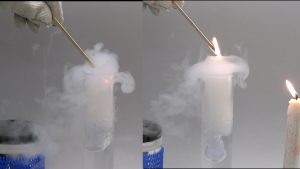
Description: A 50/50 mixture of liquid N2/O2 is poured into a beaker of room temperature water. The liquids turn to gases and as the boiling continues, more of the Oxygen gas remains as a percentage of total liquid gases in the water. After several seconds, a quenched splint ignites where a few seconds ago it would not ignite.
Source: UW Card Catalog
Year: N/A Vol: N/A Page: N/A
Keywords: Air, Oxygen, Boiling points, Combustion, Nitrogen
Rating: 

Hazard: Medium
- Cryogenic burn hazard
- Contains gas under pressure/ explosion hazard
- Asphyxiation hazard
- Inhalation hazard
- Oxidizer
- Implosion hazard
- Electric shock hazard
Effectiveness: Average
- Results are observable with guidance
- Somewhat connected to course material
- Mild effects are seen by audience
- Time to results is medium
- Contrast between behavior of systems is noticeable
- Good reliability
Difficulty: Medium
- Demos at non-standard conditions
- Some intermediate steps to results
- Use of scientific equipment
- Some careful manipulations is required
- Simple procedures
Safety Precautions:
- Eye protection required
- Gloves required
- Cryogenic gloves required
- Protective clothing recommended
- Prepare in a well-ventilated area
- Use UL approved three-prong plug and outlet
- ABC fire extinguisher on hand
Class: Intermolecular Forces, Separations
Division: General Chemistry
Return to General Chemistry Demonstrations