Organic Chemistry- Reaction Intermediates in Organic Chemistry
Bromination of Saturated and Unsaturated Hydrocarbons
Blue Bottle
Dehydration of Sugar by Sulfuric Acid
Disappearing Coffee Cup
Formation of a Silver Mirror
Models 360
Nylon 6 – 10
Organic Synthesis With Familiar Materials
Oxidation of Primary, Secondary, Tertiary Alcohols
Oxidation of Luminol
Polyurethane Foam
Slime
Underwater Fireworks: Chlorination of Acetylene
Carbide Lamp
Differences in Miscibility of Organic Alcohols With Increasing Chain Length
Combustion of Cellulose Nitrate (Guncotton)
Different Smells of Carvone Isomers
Distinguishing Between HD and LD Polyethylene
Enviro-Bond: Cleaning Oil Spills
Esterification Using a Dean-Stark Trap
Ethanol Cannon
Happy/Sad Balls
IR Demonstration – Atomic Coupling
IR Demonstration II – Molecular Vibrations
IR Demonstration III – Molecular Vibrations
Making a Rubber Ball from Latex
Plastic Samples
Reaction Intermediates in Organic Chemistry
Reducing Sugars and Fehling’s Solution
Rod Climbing by a Polymer Solution
Rotating Rainbows
Silly Putty
Soap Emulsifies Hydrocarbons
Superabsorbent Polyacrylate Gel
Tubeless Siphon
Alkimers
Aniline Hydrochloride-Formaldehyde Polymer
Phenol-Formaldehyde Polymer
Saponification
Relative Reactivity of Reducing Agents
Electrophilic Aromatic Substitution Reaction/EAS Reaction
Reactivity of Alkanes vs Aromatic Compounds
Inductive Effect
Optical Activity of Racemic Mixtures With Limonene
Relationship of Absorbed Light to Observed Color
Density and Miscibility of Liquids
Extraction of Copper Ions from Solution with Orform®
Gel Formation with Sodium Alginate and Calcium Chloride
Ozonolysis
Hydrolysis of T-Butyl Chloride: A Lecture and Lab Experiment
Terephthalate Monomerization
Reaction Intermediates in Organic Chemistry
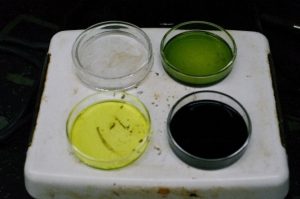 Description A set of 4 Petri dishes are filled with a mixture of 7,7,8,8, tetracyanoquinodimethane (TCNQ) in Diglyme are placed on an overhead projector table and warmed with the lamp. Portions of Morpholine in Diglyme are added to the four petri dishes. The color of the solution in the dishes is dependent on the species in the liquid. The dye itself is pale yellow, the first product, the TCNQ anion radical is green, and the first substitution product is dark blue. The third species the second Substitution product, is generated by step addition of morpholine to the final petri dish, yielding a bright golden color.
Source: Novaki, L.P., Brotero,P. P., El Seoud, O. A., Journ. Chem Educ. (1989) Vol 66 No. 12 pp.1040-1041
Year: 1989 Vol: 66, No.12 Page: 1040 – 1041
Keywords: EAS, Intermediate, Substitution, Organic Chemistry, Aromaticity, Conjugation, Delocalization
Rating:


 Hazard: Medium
- Cyanide by-product
- Acute toxicity hazard – oral, dermal, inhalation
- Aquatic toxicity hazard
- Skin corrosion hazard
- Serious eye damage hazard
- Flammability hazard
- Reproductive toxicity hazard
- Electric shock hazard
- Good connection from demo to course material
- Results are observable without guidance
- Time to results is high
- Moderate reliability
- Contrast between systems behavior is clear
- Prior training required
- Handling of organic chemicals
- Multi-step procedure with varying results
- Requires precise temperature control
- Eye protection required
- Gloves required
- Lab coat required
- Face shield recommended
- Avoid exposure to dust, vapors, liquids, or mists
- Prepare agents in a working fume hood
- Absorbent materials on hand
- Sodium hydroxide or sodium hypochlorite on hand
- Perform in a well-ventilated area
- Use of UL approved three-prong plug and outlet
Class: Organic Chemistry, Reaction Mechanisms
Division: General, Organic Chemistry
Return to General Chemistry Demonstrations