Types of Chemical Reactions- Luminol Reaction with Hemin
Electrical Conductivity of Liquids and Solutions
Lecture Size Breath Alcohol Test
Reaction of Potassium Metal with Bromine
Reduction of Copper Oxide by Hydrogen
Using Large Glass Cylinders to Demonstrate Precipitation Reactions
Coin Operated Red, White, and Blue Fountain: Reaction of Nitric Acid and Copper
Conductivity of Acetic Acid-Water Mixtures
Effect of Ion-Exchange Resin on Conductivity
Oxidation of Chloride Ion by Permanganate
Luminol Reaction with Hemin
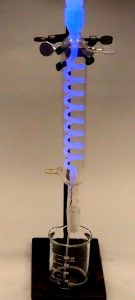
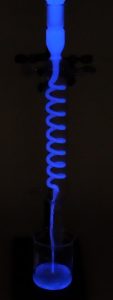
Description: An aqueous solution of sodium carbonate, luminol, and hydrogen peroxide is combined with Hemin suspended in 0.01M NaOH or as a solid on a sucrose granule. The reaction glows very brightly blue for between one and two minutes. Other variations involving sensitizers may be added in the future.
[OH−]
Luminol C8H7O2N3(aq) + H2O2(aq) ↔ C8H5O2N2−(aq) + 2H2O + N2(g) + hv ~ 465 nm
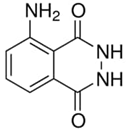
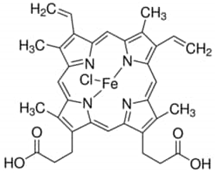
Luminol Hemin
Source: Maynard, J.H., Vinokur, J.V.
Year: 2022 Vol: N/A Page: N/A
Keywords: Luminol, Chemiluminescence, Diels-Alder, Oxidation, Spin state
Rating: 

Hazard: Some
- Eye irritation
- Skin irritation
- Serious eye damage
- Short-term (acute) aquatic hazard
- Long-term (chronic) aquatic hazard
Effectiveness: Good
- Results are clearly observable without guidance
- Contrast between behavior of systems is clear
- Time to results is low
- Strong effects are observed by audience
Difficulty: Medium
- Adding reagents in concert or timed
- Some concerted or sequential manipulations
- Procedures with some intermediate steps to results
Safety Precautions:
- Eye protection required
- Gloves required
- Avoid exposure to mists, droplets, and vapors
- Use UL approved three-prong plug and outlet
- Avoid release of reagents to the environment
Class: Reduction and Oxidation Reactions, Properties of Solutions, Types of Chemical Reactions
Division: General, Organic Chemistry
Return to General Chemistry Demonstrations