Types of Chemical Reactions- Effect of Ion-Exchange Resin on Conductivity
Electrical Conductivity of Liquids and Solutions
Lecture Size Breath Alcohol Test
Reaction of Potassium Metal with Bromine
Reduction of Copper Oxide by Hydrogen
Using Large Glass Cylinders to Demonstrate Precipitation Reactions
Coin-Operated Red, White, Blue Fountain: Reaction of Nitric Acid and Copper
Conductivity of Acetic Acid – Water Mixtures
Effect of Ion – Exchange Resin on Conductivity
Oxidation of Chloride Ion by Permanganate
Effect of Ion-Exchange Resin Conductivity
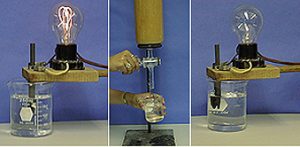
Description: The conductivity of salt solutions are tested before and after they are run through anion-exchange columns.
Source: Shakhashiri, B.Z. Chemical Demonstrations: A Handbook for Teachers of Chemistry
Year: 1989 Vol: 3 Page: 146
Keywords: Salt solutions, Anion-Exchange columns, Conductivity
Rating: 

Hazard: Some
- Electrocution hazard
Effectiveness: Good
- Good connection from demo to course material
- Time to results is medium
- Good reliability
- Mild effects are seen by audience
- Secondary observations are seen by audience
Difficulty: Medium
- Use of conductivity apparatus
- Some intermediate steps to results
- Simple procedures
- Sequential manipulations
Safety Precautions:
- Gloves required
- Eye protection required
- Insulated spatula required
- Isolation transformer recommended
- Use UL approved three-prong plug and outlet
Class: Separation Techniques, Solutions and Colloids, Conductivity
Division: General, Analytical Chemistry
Return to General Chemistry Demonstrations