Kinetics- Temperature Effect on Reaction Rate
Briggs-Rauscher Reaction
Burning Rate Depends on Oxygen Concentration
Chemical Genie in a Bottle
Iodine Clock Reaction
Kinetics of Crystal Violet
Kinetics of the Decomposition of Hydrogen Peroxide by Permanganate
Kinetics of Oxidation of Iodide Ion by Peroxide
Light Sticks
Reaction Rate Depends on Particle Size
Visible Reactive Intermediate
Autocatalysis of Oxalate Ion With Permanganate
Catalytic Combustor
Catalytic Decomposition of Hydrogen Peroxide
Elephant’s Toothpaste
Explosions of Lycopodium and Other Powders
Medicine Cabinet Kinetics
Old Nassau: The Landolt Reaction With Mercury Indicator
Traveling Waves of Color
Catalytic Oxidation of Ammonia
Ignition of Hydrogen on a Platinum Catalyst
Slow Decolorization of Permanganate by Ethanol
Temperature Effect on Reaction Rate
CMW Two Stage Clock Reaction
An Orange Clock Reaction
The Reaction Between Oxalate Ion With Permanganate
Demonstration of Chemical Inhibition
Temperature Effect on Reaction Rate
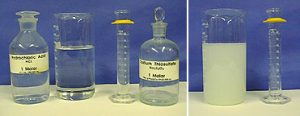
Description: The reaction between acid and thiosulfate, which produces a precipitate of sulfur, is shown at two different temperatures. Sulfur appears faster at the higher temperature.
Source: UW Card Catalog
Year: N/A Vol: N/A Page: N/A
Keywords: Hydrochloric acid, Sodium thiosulfate, Precipitation, Temperature, Kinetics
Rating: 
Hazard: Some
- Acute toxicity hazard
- Skin corrosion hazard
- Corrosive to metals
- Inhalation hazard
- Electric shock hazard
- Serious eye damage
Effectiveness: Average
- Results are observable with guidance
- Somewhat connected conceptually to course material
- Mild effects are seen by audience
- Time to results is medium
- System contrast is noticeable
Difficulty: Medium
- Procedures with some intermediate steps to results
- Reactions or demos at non-standard conditions
- Simple manipulations for most to perform
Safety Precautions:
- Eye protection required
- Gloves required
- Absorbent materials on hand
- Use UL approved three-prong plug and outlet
- Avoid exposure to mists and vapors
- Perform in a well-ventilated area
Class: Kinetics
Division: General
Return to General Chemistry Demonstrations