Organic Chemistry- Ethanol Cannon
Bromination of Saturated and Unsaturated Hydrocarbons
Dehydration of Sugar by Sulfuric Acid
Organic Synthesis With Familiar Materials
Oxidation of Primary, Secondary, Tertiary Alcohols
Underwater Fireworks: Chlorination of Acetylene
Differences in Miscibility of Organic Alcohols With Increasing Chain Lengths
Combustion of Cellulose Nitrate (Guncotton)
Different Smells of Carvone Isomers
Distinguishing Between HD and LD Polyethylene
Enviro-bond: Cleaning Oil Spills
Esterification: Using a Dean-Stark Trap
IR Demonstration I – Atomic Coupling
IR Demonstration II – Molecular Vibrations
IR Demonstrations III – Molecular Vibrations
Making a Rubber Ball from Latex
Reaction Intermediates in Organic Chemistry
Reducing Sugars and Fehling’s Solution
Rod Climbing by a Polymer Solution
Superabsorbent Polyacrylate Gel
Aniline Hydrochloride-Formaldehyde Polymer
Relative Reactivity of Reducing Agents
Electrophilic Aromatic Substitution Reaction/EAS Reaction
Reactivity of Alkanes vs Aromatic Compounds
Optical Activity of Racemic Mixtures With Limonene
Relationship of Absorbed Light to Observed Color
Density and Miscibility of Liquids
Extraction of Copper Ions from Solution with Orform®
Gel Formation with Sodium Alginate and Calcium Chloride
Hydrolysis of T-Butyl Chloride: A Lecture and Lab Experiment
Ethanol Cannon
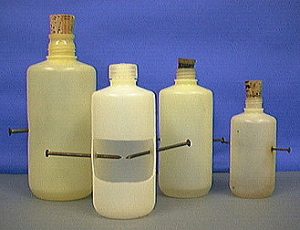
Description: Plastic containers are filled with a small amount of ethanol and a cork is placed on the top. Touching the nails on the outside of the containers with a Tesla coil causes a spark inside the container which ignites the ethanol vapor, and the cork blows off.
Source: Shakhashiri, B.Z. Chemical Demonstrations: A Handbook for Teachers of Chemistry
Year: 1985 Vol:2 Page: 216
Keywords: Ethanol, Cork, Tesla coil, Combustion, Spark
Rating: 

Hazard: Medium
- Electrical shock hazard
- Projectile hazard
- Flammability hazard
- Explosion hazard
- Noise hazard
- Eye irritation
Effectiveness: Good
- Somewhat connected to course material
- Results are clearly observable without guidance
- Time to results is low
- High reliability
- Strong effects are seen by audience
Difficulty: Medium
- Some sequential manipulations
- Use of reactive substances
- Use of high voltage
- Handling of organic chemicals
- Manipulations are simple for most to perform
Safety Precautions:
- Eye protection required
- Ear protection required
- ABC fire extinguisher on hand
- High ceiling (greater than three meters)
- Use caution when igniting to minimize projectile hazard
- Do not look into empty cannon bottle while energizing
Class: Combustion, Organic Chemistry, Thermodynamics
Division: General, Organic Chemistry
The demonstration Ethanol Cannon may be found under Intermolecular Forces- Liquids and Solids – Ethanol Cannon and Thermochemistry – Ethanol Cannon.
Return to General Chemistry Demonstrations