Acid and Bases- Leeching Lead Into Acidic Solution
Balloon Races- Ionization of Hydrochloric Acid and Acetic Acid
Coin-Operated Red, White, and Blue Fountain: Reaction of Nitric Acid and Copper
Conductivity and Extent of Dissociation of Acids and Bases
Fizzing Races: Ionization of HCl and Acetic Acid
Acid-Base Indicators Extracted from Plants
Acidic and Basic Properties of Oxides
Acidic and Basic Properties of Salts
Acidity of Aluminum Chloride in Solution
Amphoteric Properties of Aluminum Hydroxide
Classical Properties of Acids and Bases
Food is Acidic: Cleansers are Basic
Leeching Lead into Acidic Solution
Acid and Ammonium Hydroxide Solubility Effect
Fizzing and Foaming: Reactions of Acids and Carbonates
Leeching Lead Into Acidic Solution
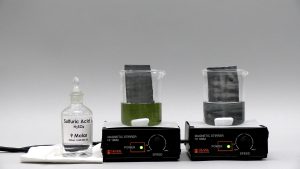
Description: Two samples of lead metal Pb (s) are each placed in 250 mL beakers with 100 mL 0.1 M KI (aq). ~1mL of 9 M H2SO4(aq) is added to one of the samples. The other serves as a reference. The acidified sample leeches lead into solution which reacts with KI (aq) to form PbI2 (s), a bright yellow precipitate which collects on the lead surface. The precipitation of PbI2(s) from 0.1M Pb(NO3)2(aq) and 0.1M KI (aq) can be performed as a precursor to the experiment.
Source: Maynard, J.H. via consult with Prof. Landis, C.R. Prof. Moore, J. W UW–Madison
Year: 2018 Vol: N/A Page: N/A
Keywords: Precipitate, pH, Lead, Solubility
Rating: 

Hazard: Medium
- Acute toxicity hazard
- Aquatic toxicity hazard
- Carcinogenicity
- Mutagenicity
- Thyroid toxicity
- Skin corrosion hazard
- CNS toxicity
Effectiveness: Average
- Good connection from demo to course material
- Results are observable with guidance
- Mild effects are seen by audience
- Time to results is medium
Difficulty: Medium
- Some intermediate steps to results
- Some sequential manipulations
- Use of toxic chemicals
Safety Precautions:
- Eye protection required
- Gloves required
- Perform in a well-ventilated area
- Absorbent material on hand
- Perform on a chemically resistant surface
- Sodium bicarbonate on hand
- Prevent release of reagents to the environment
Class: Acids and Bases, Transition Metal Chemistry
Division: General
Return to General Chemistry Demonstrations