Properties of Solutions- Volume Increase Upon Neutralization
Volume Increase upon Neutralization
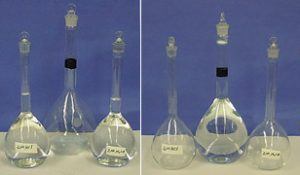
Description: When equal volumes of strong aqueous acid and base are mixed, the resulting volume is more than the simple sum of the volumes, due to the formation of water.
Source: Shakhashiri, B.Z. Chemical Demonstrations: A Handbook for Teachers of Chemistry
Year: 1989 Vol: 3 Page: 276
Keywords: Acid Base Chemistry, Water, Hydrochloric acid, Sodium hydroxide
Ratings: 


Hazard: Medium
- Serious eye damage hazard
- Corrosive to metals
- Skin corrosion hazard
- Inhalation hazard
- Acute toxicity hazard
Effectiveness: Good
- Good connection from demo to course material
- Some contrast between system behavior
- Results can be observed with guidance
- Low failure rate
- Time to result is medium
Difficulty: Medium
- Careful manipulations required
- Procedures with some intermediate steps to results
- Demos in which a display is used
- Volume dependent addition for proper results
Safety Precautions:
- Gloves required
- Eye protection required
- Chemically resistant surface required
- Sodium bicarbonate on hand
- Absorbent materials on hand
- Uses UL approved three-prong plug and outlet
- Perform in a well-ventilated area
- Prevent release of reagents to the environment
Class: Intermolecular Forces, Solubility, Properties of Solutions, Acid-base Reaction, Thermodynamics
Division: General, Physical Chemistry
Home| General Chemistry Demos| Physical Chemistry Demos