Equilibrium of Chemical Systems- Making Liquids Immiscible II
Equilibrium Between Nitrogen Dioxide and Dinitrogen Tetroxide
Effect of Pressure on Melting Point of Ice
The Liquid Phase of Carbon Dioxide
Vapor Pressure of Pure Liquids
Getting Colder: Freezing-Point Depression
Getting Hotter: Boiling-Point Elevation by Nonvolatile Solutes
Osmotic Pressure of a Sugar Solution
Vapor Pressure of Solutions: Raoult’s Law
Boiling Two Liquids at Room Temperature
Salting Out: Making Liquids Immiscible
Electrolysis of Potassium Iodide
Hydrogen Ion Concentration Cell
Acid-Base Properties of Amino Acids
Electrical Conductivity of Liquids and Solutions
Making Liquids Immiscible II
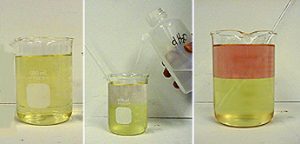
Description: Hexane and ethanol are mixed in equal portions (with a little iodine to increase visibility). A few drops of water are added to the solution, and two liquid phases are produced.
Source: Randy Wolff
Year: 1976 Vol: N/A Page: N/A
Keywords: Hexane, Phase separation, Ethanol, Water
Ratings: 

Hazard: High
- Flammable liquids
- Skin irritation
- Reproductive toxicity
- Specific target organ toxicity – single exposure, central nervous system
- Specific target organ toxicity – repeated exposure, nervous system
- Aspiration hazard
- Short-term (acute) aquatic hazard
- Long-term (chronic) aquatic hazard
- Acute toxicity hazard – oral, eyes
- Eye irritation
Effectiveness: Good
- Results are clearly observable without guidance
- Low failure rate
- Good connection from demo to course material
- Time to results is low
Difficulty: Medium
- Use of organic chemicals
- Simple procedures
- Simple manipulations for most to perform
Safety Precautions:
- Gloves required
- Eye protection required
- No open flames during performance
- ABC fire extinguisher on hand
- Absorbent materials on hand
- Chemically resistant surface recommended
- Prevent release of reagents to the environment
- Perform in a well ventilated area
- Avoid exposure to mists, droplets, and vapors
Class: Intermolecular Forces, Solubility, Property of Solutions, Equilibrium of Chemical Systems
Division: General, Physical Chemistry
Return to Physical Chemistry Demonstrations