Transition Metals and Coordination Compounds- Oxidation States of Vanadium
Chloro Complexes of Cobalt (II)
Color Fan
Oxidation States of Vanadium
Precipitates and Complexes of Nickel (II)
Precipitates and Complexes of Silver (I)
Formation of a Silver Mirror
Spectroscopy for Large Lecture Hall II
Bromo Complexes of Copper (II)
Colorful Complex Ions in Ammonia
Colors of Complexes of Transition Metals
Hydration of Cu (II) Ion
Iron (III) Thiocyanate Complex Ion Equilibrium
Precipitates and Complexes of Copper (II)
Precipitates and Complexes of Iron (III)
Relationship of Absorbed Light to Observed Color
Samples of Minerals
The Copper Mirror
Reduction of Permanganate Ion by Sulfite Ion
Slow Formation of Chloro Complex of Chromium (III) Ion
Oxidation States of Vanadium (II) with Permanganate
Oxidation States of Vanadium
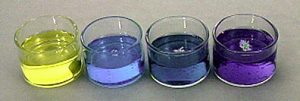
Description: Yellow vanadium (VI) is swirled with Jones Reductor and will progressively change color until it reaches the violet vanadium (II). Vanadium (II) is oxidized through a series of colors by permanganate to a final yellow color.
Source: UW Card Catalog
Year: N/A Vol: N/A Page: N/A
Keywords: Oxidation states, Jones Reductor, Vanadium (II), Permanganate
Ratings: 


Hazard: High
- Corrosive to metals
- Skin corrosion hazard
- Serious eye damage
- Acute toxicity hazard – oral, inhalation, dermal
- Aquatic toxicity hazard
- Specific organ toxicity repeated exposure – respiratory tract
- Oxidizing liquids
- Carcinogenicity hazard
Effectiveness: Good
- Good connection from demo to course material
- Results are clearly observable without guidance
- Time to results is low
- Reliability is good
- Mild effects are seen by audience
Difficulty: Medium
- Consecutive manipulations and transfer
- Training or practice recommended
- Manipulations are simple for most to perform
- Attention to detail is required
- Some intermediate steps to results
Safety Precautions:
- Eye protection required
- Gloves required
- Use of chemically inert surface
- Absorbent material on hand
- Avoid exposures to mists, droplets, or vapors
- Perform in a well-ventilated area
- Prevent release of reagents to the environment
Class: Transition Metal Chemistry, Redox Reactions
Division: General, Inorganic Chemistry, Analytical Chemistry
The demonstration Oxidation States of Vanadium may be found under Types of Chemical Reactions- Oxidation States of Vanadium.
Return to General Chemistry Demonstrations