Biochemistry- Luminol Reaction with Hemin
Acid-Base Properties of Amino Acids
Curdling of Milk
Denaturing and Precipitating Proteins
Enzymatic Activity of Glucose Oxidase
Gel Filtration Chromatography
HIV-1 Protease: An Enzyme at Work
Precipitating Genomic DNA
Studying Enzyme Kinetics Using Catalase
What Color is Egg White
Binding of Coomassie Brilliant Blue to Egg Albumin
Blood Glucose Meter
Breaking Down Sucrose Using Invertase
Color Reactions of Amino Acids
Dialysis of a Mixture
Effect of pH on Protein Solubility
Enzyme Catalyzed Decomposition of Hydrogen Peroxide
Enzyme Kinetics: Experiments With Catalase Extract
Halting the Briggs-Rauscher Reaction
Hydrolysis of Wool in Strong Base
Dyeing of Wool With Martius Yellow
Protein Synthesis
Luminol Reaction with Hemin
Luminol Reaction with Hemin
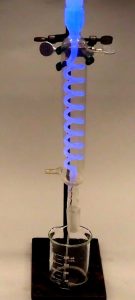
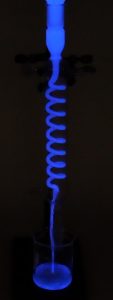
Description: An aqueous solution of sodium carbonate, luminol, and hydrogen peroxide is combined with Hemin suspended in 0.01M NaOH or as a solid on a sucrose granule. The reaction glows very brightly blue for between one and two minutes. Other variations involving sensitizers may be added in the future.
[OH−]
Luminol C8H7O2N3(aq) + H2O2(aq) ↔ C8H5O2N2−(aq) + 2H2O + N2(g) + hv ~ 465 nm
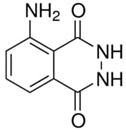
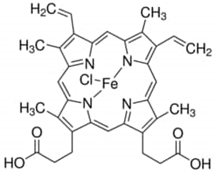
Luminol Hemin
Source: Maynard, J.H., Vinokur, J.V.
Year: 2022 Vol: N/A Page: N/A
Keywords: Luminol, Chemiluminescence, Diels-Alder, Oxidation, Spin state
Rating: 

Hazard: Some
- Eye irritation
- Skin irritation
- Serious eye damage
- Short-term (acute) aquatic hazard
- Long-term (chronic) aquatic hazard
Effectiveness: Good
- Results are clearly observable without guidance
- Contrast between behavior of systems is clear
- Time to results is low
- Strong effects are observed by audience
Difficulty: Medium
- Adding reagents in concert or timed
- Some concerted or sequential manipulations
- Procedures with some intermediate steps to results
Safety Precautions:
- Eye protection required
- Gloves required
- Avoid exposure to mists, droplets, and vapors
- Use UL approved three-prong plug and outlet
- Avoid release of reagents to the environment
Class: Biochemistry, Chemiluminescence, Catalysis
Division: General, Biological Chemistry
Return to General Chemistry Demonstrations