Aqueous Equilibrium and Precipitation Reactions- Solubility of Copper Oxide in Water vs Acid
Common Ion Effects with Lead Iodide
Precipitates and Complexes of Copper (II)
Precipitates and Complexes of Nickel (II)
Precipitates and Complexes of Silver (I)
Precipitating Silver with Chromate and Chloride Ions
Cadmium Sulfide Precipitates as a Function of H+ Concentration
Precipitates and Complexes of Iron (III)
Precipitating Sodium Chloride From Its Solution
Precipitations of Lead Chloride from a Saturated Solution
Reaction Between Carbon Dioxide and Limewater
Silver Chloride Dissolves in Excess Chloride Ion
Solubility of Copper Oxide in Water vs Acid
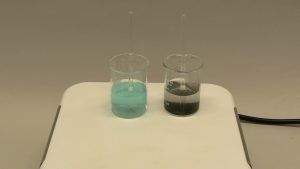
Description: Two 100-200 mg samples of Copper Oxide are added to 50 ml samples of water and 2 M Sulfuric acid. Each sample is stirred and heated to 80˚C. The sample in water remains a solid in the beaker, and the acid sample dissolves to form the blue copper sulfate complex. Similar chemistry may be performed using Copper Sulfide in place of Copper Oxide. This experiment may be scaled up for use in larger venues.
Heat 80˚C
CuO(s) + H2O(l) → No Reaction
CuO(s) + H2SO4(aq) → Cu+2(aq) + SO4-2(aq) + H2O(l)
CuS(s) + H2O(l) → No reaction
CuS(s) + H2SO4(aq) → Cu+2(aq) + SO4−2(aq) + H2S(aq)
Source: Landis, C.R. Prof. (Personal Communication), UW Card catalog
Year: 2014 Vol: N/A Page: N/A
Keywords: Oxides, Solubility, Acid, Heat, Copper
Rating: 

Hazard: Some
- Short-term (acute) aquatic hazard
- Long-term (chronic) aquatic hazard
- Corrosive to metals
- Skin corrosion hazard
- Serious eye damage
- Acute toxicity- oral, inhalation
- Flammable gases
- Gases under pressure
- Burn/Scalding hazard
- Electric shock hazard
- Demos at non-standard conditions
- Use of reactive reagents
- Chemicals that are toxic to the environment in use
Effectiveness: Good
- Results are observable without guidance
- Good connection from demos to course material
- Time to results is medium
- Good reliability
Difficulty: Medium
- Use of scientific equipment
- Some timed manipulations
- Simple procedures
- Use of mildly reactive substances
Safety Precautions:
- Eye protection required
- Gloves required
- Thermal gloves recommended
- Prevent release of reagents to the environment
- Use of UL approved three-prong plug and outlet
- Perform on a chemically resistant surface
- Avoid exposure to mists, droplets, and vapors
- ABC fire extinguisher on hand
Class: Solubility, Transition Metals
Division: General, Inorganic Chemistry
Return to General Chemistry Demonstrations