Equilibrium- Chromate-Dichromate Equilibrium
Chromate-Dichromate Equilibrium
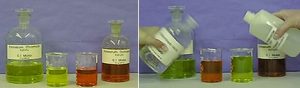
Description: Yellow chromate ion is turned orange by addition of acid. The orange dichromate is returned to yellow by the addition of base. The change may be repeated several times. This illustrates LaChatelier’s Principle.
Source: UW Card Catalog
Year: N/A Vol: N/A Page: N/A
Keywords: Chromate ion, Acid, Base, Equilibrium, LaChatelier’s Principle.
Rating: 


Hazard: High
- Skin corrosion hazard
- Acute toxicity hazard – inhalation, oral, dermal
- Serious eye damage
- Carcinogenicity hazard
- Reproductive toxicity
- Germ cell mutagenicity hazard
- Oxidizing solids
- Corrosive to metals
- Aquatic toxicity hazard
Effectiveness: Good
- Results are clearly observable without guidance
- Good connection from demo to course material
- High reliability
- Time to results is low
Difficulty: Medium
- Sequential manipulations of reagents
- Procedures with some intermediate steps to results
- Demos in which toxic reagents are in use
Safety Precautions:
- Eye protection required
- Gloves required
- Perform in a well-ventilated area
- Absorbent material on hand
- Sodium bicarbonate on hand
- Avoid exposure to dusts, mists, or droplets
- Prevent release of reagents to the environment
Class: Equilibrium, Acids and Bases, Transition Metals
Division: General, Inorganic Chemistry
Home| General Chemistry Demonstrations| Inorganic Chemistry Demonstrations