Thermodynamics- Collapsing Can
Diffusion of Bromine Vapor
Adiabatic Gas Expansion
Explosive Decomposition of Nitrogen Triiodide
Volume Increase Upon Neutralization
You Can’t Go Back
Dissolution of a Binary Mixture
Heat Capacity of Water
Shapes of Soap Films and Bubbles
Surface Spreading and Surface Tension
Surface Tension of Water: The Floating Paper Clip
Will a Tissue Hold Water? Interfacial Tension
Calorimeters
Surface Tension: Floating Duck
Effect of Heating a Rubber Band and a Spring
Surface Tension With Oil and Pepper
Household Chemical Density Column
Lead Balloon
Evaporation as an Endothermic Process
Collapsing Aluminum Can
Collapsing Can
Thermal Expansion of Gases
Density and Miscibility of Liquids
Using Liquid Nitrogen to Do Work
Collapsing Can
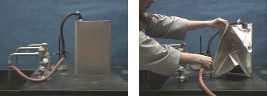 Description: A 5-gallon metal can is collapsed under external air pressure either by evacuating the can, or boiling water in it, sealing the can and allowing it to cool.
Description II: Water is boiled in a square can. The can is quickly inverted into a container of water, and the can spontaneously crushes. This demo can also be performed using a vacuum pump to remove air from the can, until atmospheric pressure is sufficient to collapse it.
This demonstration is also available on video and JCE “Chemistry Comes Alive!” Vol. 1 CD-Rom.
Source: Shakhashiri, BZ Chemical Demonstrations: A Handbook for Teachers of Chemistry
Year: 1985 Vol: 2 Page: 6
Keywords: Water, Vacuum, Square can, Pressure, Collapse, Force
Rating:


 Hazard: Some
- Electric shock hazard
- Slip hazard
- Flammability hazard
- Burn hazard
- Clearly observable without guidance
- Good connection from demo to course material
- Low failure rate
- Time to results is low
- Clear contrast between behavior of systems
- Simple manipulations for most to perform
- Some intermediate steps to results
- Simple procedures
- Demos at non-standard conditions
- Gloves recommended
- Eye protection required
- Absorbent material on hand
- Flame resistant surface recommended
- Use of UL approved three-prong plug and outlet
Class: Gas Law, Intermolecular Forces
Division: General, Physical Chemistry
Return to Physical Chemistry Demonstrations