Equilibrium of Chemical Systems- Equilibrium Between Nitrogen Dioxide and Dinitrogen Tetroxide
Equilibrium Between Nitrogen Dioxide and Dinitrogen Tetroxide
Effect of Pressure on Melting Point of Ice
The Liquid Phase of Carbon Dioxide
Vapor Pressure of Pure Liquids
Getting Colder: Freezing-Point Depression
Getting Hotter: Boiling-Point Elevation by Nonvolatile Solutes
Osmotic Pressure of a Sugar Solution
Vapor Pressure of Solutions: Raoult’s Law
Boiling Two Liquids at Room Temperature
Salting Out: Making Liquids Immiscible
Electrolysis of Potassium Iodide
Hydrogen Ion Concentration Cell
Acid-Base Properties of Amino Acids
Electrical Conductivity of Liquids and Solutions
Equilibrium Between Nitrogen Dioxide and Dinitrogen Tetroxide
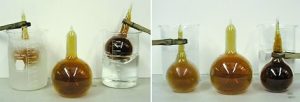
Description: Heating and cooling flasks of NO2 and N2O4 shift the equilibrium between the two species. When more NO2 is produced, the color of gas inside the flask becomes darker.
Source: Shakhashiri, B.Z. Chemical Demonstrations: A Handbook for Teachers of Chemistry
Year: 1985 Vol: 2 Page: 180
Ratings: 


Keywords: Equilibrium, Dinitrogen Tetroxide, Nitrogen Dioxide, Temperature, LaChatelier’s Principle, Raoult’s Law, Beer’s Law
Hazard: Medium
- Use of toxic gas – sealed vessels
- Demo at non-standard conditions
- Electric shock hazard
- Asphyxiation hazard
- Flammable liquids – when acetone bath is used
- Eye irritation
- Cryogenic burn hazard
- Specific organ toxicity – CNS when acetone bath is used
Effectiveness: Good
- Results are clearly observable with guidance
- Good connection from demo to course material
- Clear contrast between behavior of systems
- Time to results is medium
- Mild effects are seen by audience
Difficulty: Medium
- Physical manipulation of reagents – use of hot bath and cold bath
- Handling of toxic reagents
- Procedure with some intermediate steps
- Temperature dependent results
Safety Precautions:
- Perform in a well-ventilated area
- Eye protection required
- Temperature-resistant gloves required
- Use of UL approved three-prong plug and outlet
- Absorbent material on hand
- ABC fire extinguisher on hand
- Avoid exposure to droplets, mists and vapors
- Handle gas flasks with care
Class: Equilibrium, Gases, Entropy, Thermodynamics, Groups IVB and VB (under 14 and 15)
Division: General, Inorganic Chemistry, Physical Chemistry
Return to Physical Chemistry Demonstrations