Groups VIA and VIIA (16 and 17)- Dehydration of Sugar by Sulfuric Acid
Acidic and Basic Properties of Oxides
Ozone Casts a Shadow in UV Light
Preparation and Properties of Liquid Oxygen
Dehydration of Sugar by Sulfuric Acid
Preparation and Properties of Sulfur Dioxide
Plastic Sulfur
Reaction of Chlorine and Aluminum
HCl Cannon
Reaction of Chlorine and Iron
Buffering Action and Capacity
Dehydration of Sugar by Sulfuric Acid
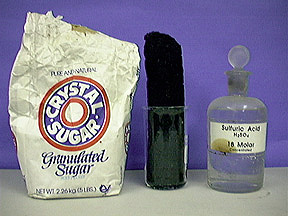
Description: Concentrated sulfuric acid is added to sugar in a beaker and stirred. The mixture changes color from white crystalline solid to a black amorphous solid. The solid expands out of the beaker, accompanied by the evolution of heat, sulfur oxides, and the smell of burned sugar and sulfur dioxide.
Source: Shakhashiri, B.Z. Chemical Demonstrations: A Handbook for Teachers of Chemistry
Year: 1983 Vol: 1 Page: 77
Keywords: Sulfuric Acid, Exothermic, Sugar, Dehydration
Rating: 


Hazard: High
- Acute toxicity hazard
- Chemical burn hazard
- Skin corrosion hazard
- Inhalation hazard
- Thermal burn hazard
- Serious eye damage hazard
Effectiveness: Excellent
- Results are deeply engaging to audience
- Spectacular effects are seen by audience
- Superior reliability
- Clear contrast between behavior of systems
- Time to results is low
- Good connection from demo to course material
Difficulty: Medium
- Some intermediate steps to results
- Some timed manipulations
- Reactions in which toxic substances are produced
- Simple procedures
Safety Precautions:
- Eye protection required
- Chemical and thermal gloves required
- Downdraft hood or fume hood required
- Chemically resistant surface required
- Acid neutralization spill kit required
- Avoid exposure to evolved gases
Class: Organic Chemistry, Dehydration Reaction, Groups VIA and VIIA (16 and 17), Main Group Elements
Division: General, Organic Chemistry
Return to Inorganic Chemistry Demonstrations