Groups IV, V, IVB and VB (14 and 15)- Properties of Nitric Oxide
Extinguishing Candles With Carbon Dioxide
Preparation and Properties of Carbon Dioxide
Colorful Stalagmites: The Silicate Garden
Samples of Silicate Minerals
Equilibrium Between Nitrogen Dioxide and Dinitrogen Tetroxide
Explosive Decomposition of Nitrogen Triiodide
Properties of Nitric Oxide
Catalytic Oxidation of Ammonia
Phosphorus Writing
Leeching Lead Into Acidic Solution
Organometallics Pyrophoric Carbon
An Orange Clock Reaction
A Simple, Vivid Demonstration of Selective Precipitation
Reaction of Aluminum and Mercury (II) Chloride
Properties of Nitric Oxide
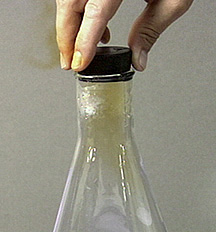
Description: Nitric oxide, a colorless, water-insoluble gas, reacts with oxygen from the air to form a red-brown gas. The gas is slightly soluble in water and forms nitrous acid in solution.
Source: UW Card Catalog
Year: N/A Vol: N/A Page: N/A
Keywords: Nitrogen (II) Oxide, Nitric Acid, Solubility, Equilibrium
Rating: 

Hazard: High
- Acute toxicity hazard- dermal
- Oxidizing gases
- Inhalation hazard
- Skin corrosion hazard
- Serious eye damage
- Corrosive to metals
Effectiveness: Average
- Somewhat connected conceptually to course material
- Mild effects are seen by audience
- Results are observable without guidance
- Time to results is low
Difficulty: Medium
- Use of reactive substances
- Reactions containing potential for the creation of toxic compounds
- Prior training recommended
- Procedures are simple
- Some careful manipulations required
Safety Precautions:
- Eye protection required
- Gloves required
- Perform in fume hood or Downdraft hood
- Perform in well-ventilated area
- Avoid contact with vapors or gases
Class: Main Group Elements, Groups IV, V, IVB, and VB (14 and 15)
Division: General, Inorganic Chemistry
Return to Inorganic Chemistry Demonstrations