Equilibrium of Chemical Systems- Water Cryophorus Tube
Water Cryophorus Tube
Equilibrium Between Nitrogen Dioxide and Dinitrogen Tetroxide
Effect of Pressure on Melting Point of Ice
Ice Bomb
The Liquid Phase of Carbon Dioxide
Vapor Pressure of Pure Liquids
The Drinking Bird
Getting Colder: Freezing-Point Depression
Getting Hotter: Boiling-Point Elevation by Nonvolatile Solutes
Model of Osmotic Pressure
Osmotic Pressure of a Sugar Solution
Vapor Pressure of Solutions: Raoult’s Law
Volume Decreases Upon Mixing
Boiling Two Liquids at Room Temperature
Salting Out: Making Liquids Immiscible
Making Liquids Immiscible II
Aluminum & Oxygen Battery
Electrolysis of Potassium Iodide
Electrolysis of Water
Voltaic Cells
Display Batteries
Fuel Cell
Hydrogen Ion Concentration Cell
Acid-Base Properties of Amino Acids
Electrical Conductivity of Liquids and Solids
Instrumental Recording of a Titration Curve
A Visual Demonstration of Raoult’s Law
Water Cryophorous Tube
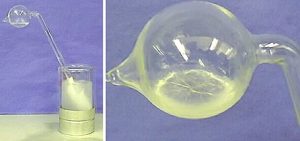
Description: A tube contains water and water vapor. When one end of the tube is cooled, the equilibrium shifts to produce more water vapor. This cools the water at the top of the tube, and it quickly freezes. Other versions of this experiment use bromine and cyclohexane.
Source: Alyea, H. N., Dutton, F.B., Baker, P. Tested Demonstrations in Chemistry/ JCE
Year:1950 Vol: 27 Page: 63/617
Keywords: Cryophorous tube, Water, Water vapor, Temperature
Rating: 


Hazard: Medium
- Implosion hazard
- Cryogenic burn hazard
- Mild asphyxiation hazard
Effectiveness: Good
- Strong effects are seen by audience
- High reliability
- Good connection from demo to course material
- Counterintuitive effects
- Time to results is medium
Difficulty: Medium
- Demo at non-standard conditions
- Procedures with some intermediate steps
- Simple manipulations for most to perform
- Demos in which a display is used
Safety Precautions:
- Eye protection required
- Cryogenic gloves required
- Lab coat recommended
- Perform in a well-ventilated area
Class: Gases, Equilibrium of Chemical Systems
Division: General, Physical Chemistry
Return to Physical Chemistry Demonstrations